
EXECUTIVE SUMMARY
AI adoption is no longer the hard part. Organizations already have copilots, agents, and employees using AI. The harder issue is whether that activity is actually improving the business. Adoption is moving faster than workflow redesign, governance, and ROI measurement.
After more than 20 years leading complex technology, operations, systems, and transformation environments, I see AI readiness as an operating-model question. Leaders need to know where value is being lost, which workflows need to change, what controls are required, where human judgment must remain, and how results will be measured.
Start with how the work actually gets done
My background is in engineering, operational transformation, program leadership, and complex systems. I have led mission-critical technology and business environments, including a $90 million global Defense systems development program portfolio. That experience shapes how I look at AI.
When a complex organization is underperforming, adding another system rarely fixes the underlying problem. You first have to understand how the work moves: where information gets trapped, where handoffs break down, which activities consume valuable expertise, how decisions are made, and what outcomes actually matter.
AI does not change that discipline. It makes it more important.
McKinsey's 2026 research makes a similar point. Most major organizations have already deployed AI tools, but relatively few have achieved meaningful enterprise-wide financial impact. The companies generating more value are redesigning workflows and operating models rather than simply using AI to accelerate existing activities.
That is where I think AI readiness has its best value. It is not about whether an organization has enough technology. It is about whether the way the organization operates can actually capture value from the technology it already has.
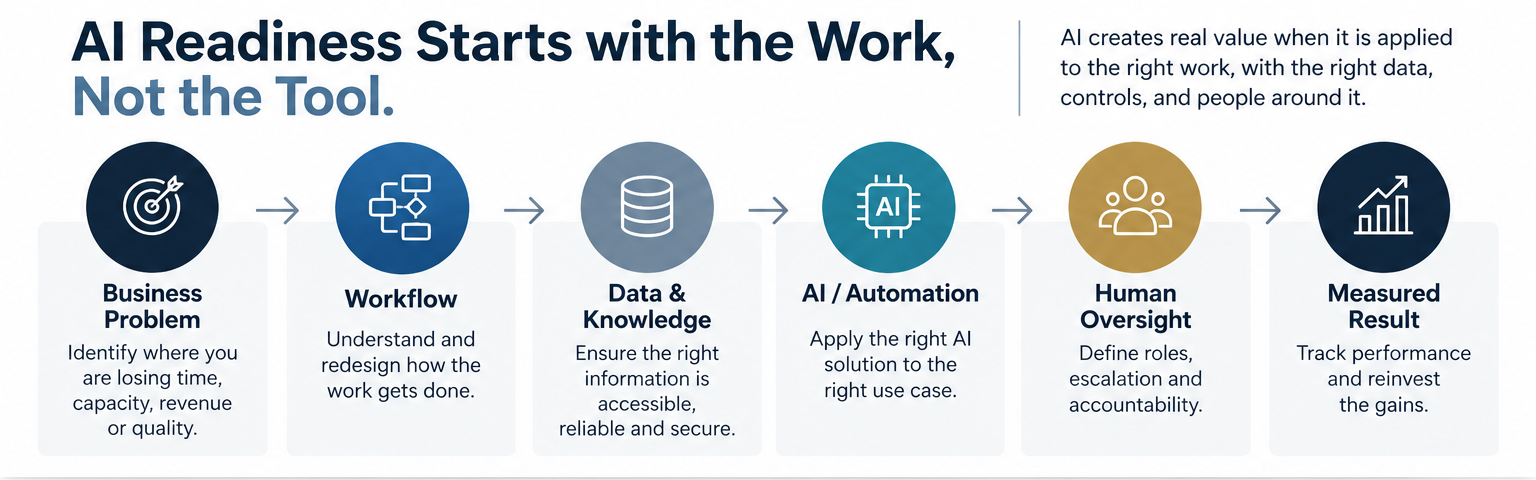
Adoption is not the same as transformation
There is a big difference between putting AI into an existing process and rethinking the process around what AI now makes possible.
That is why a useful readiness assessment should not produce another long list of AI use cases. Most organizations do not need more ideas. They need better priorities.
Where are we losing time, capacity, revenue, quality, or responsiveness? Which workflows need to be redesigned before they are automated? Is the information the process depends on accessible and reliable? Where does human judgment need to remain? Who owns the outcome? How will leadership know whether the investment worked?
For professional services firms in particular, much of the value of the business sits in human expertise. The objective should not be to automate everything possible. It should be to remove work that does not require that expertise so people can spend more time on judgment, relationships, problem-solving, and client value.
Governance has to catch up with adoption
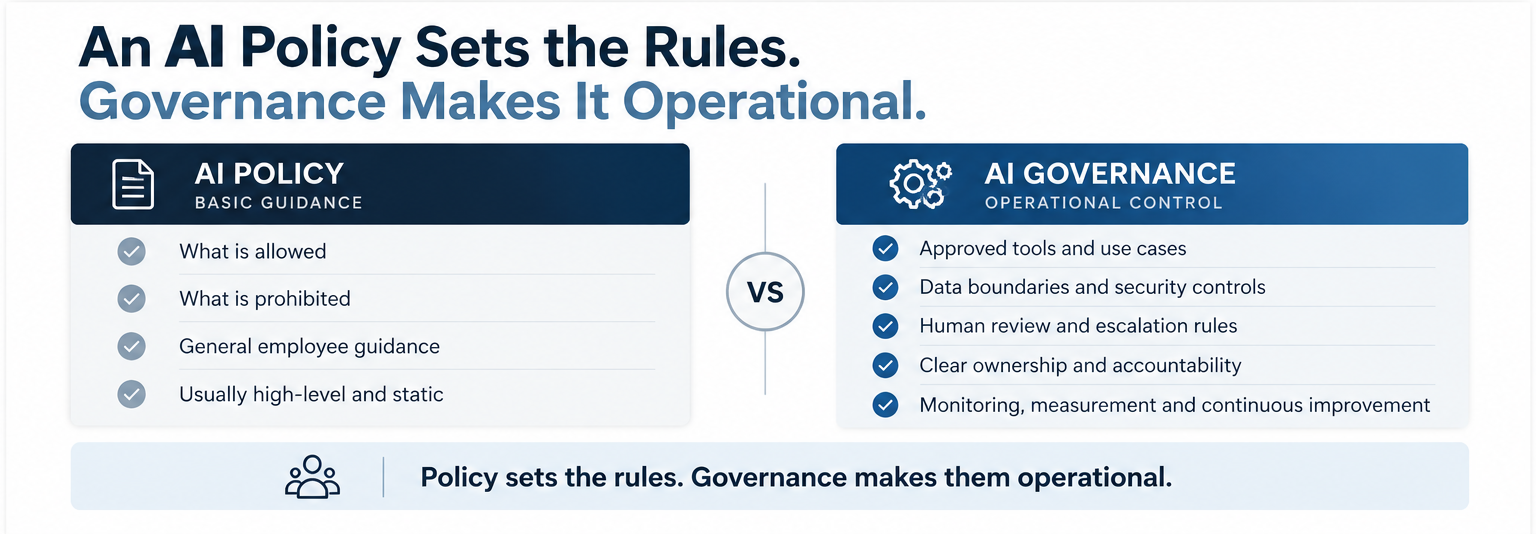
The same issue shows up on the risk side. I keep coming back to two principles: you cannot govern AI you have not inventoried, and an AI policy is not AI governance.
A policy can tell employees what is permitted. Governance addresses how AI is actually selected, deployed, controlled, and monitored. Which tools are approved? What data can they access? Where is human review required? Who owns the risk? What happens when something goes wrong? How do we know the system is producing the intended result?
The consequences of getting that wrong are no longer theoretical. In 2023, Samsung restricted employee use of public generative AI tools after sensitive internal information, including source code, was submitted to ChatGPT. Samsung did not conclude that AI was too risky to use. It later moved toward structured enterprise deployment across major business functions.
The lesson is not to stop AI adoption. It is to put the right structure around how AI is selected, deployed, governed, and measured.
AI readiness should lead to better decisions
The point of readiness is not to produce a maturity score that sits in a presentation.
Leadership should come away knowing where AI can create meaningful value now, which workflows need to change first, what risks need to be controlled, what capabilities are missing, and how results will be measured. Just as important, readiness should identify where AI should not be applied yet.
Sometimes the right answer is automation. Sometimes it is an AI agent. Sometimes the workflow needs to be simplified or redesigned through operational transformation before either makes sense. And sometimes the problem has very little to do with technology.
That is why I no longer think of AI readiness primarily as a technology assessment. It is a way to determine whether the organization's people, processes, systems, governance, and leadership are aligned well enough to turn AI capability into better execution.
Start with business processes and outcomes. Understand how work actually gets done across people, processes, and systems. Fix what's broken, reimagine what needs to change, then apply AI where it creates leverage—and measure whether it did.
How ready is your organization to put AI to work?
Get a directional view of where your organization stands across strategy, workflows, data, technology, people, governance, execution, and measurement.
Take the AI Readiness Assessment