
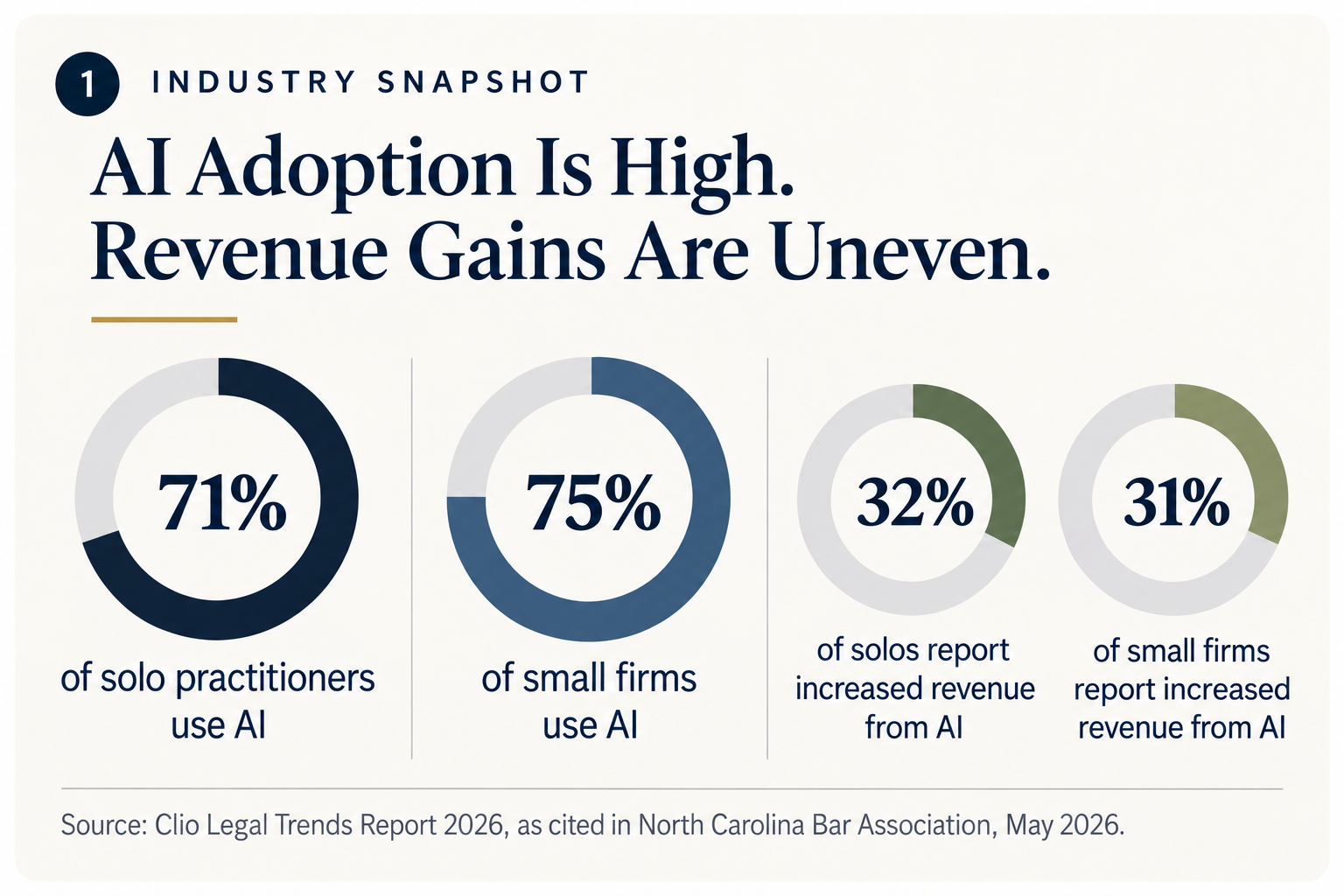
AI adoption is now widespread across the legal profession. Clio's 2026 research found that 71% of solo practitioners and 75% of small firms are using AI, yet only 32% of solos and 31% of small firms report that AI has increased revenue. The gap suggests that adoption alone is not enough. The firms getting more value from AI are finding ways to connect it to how the business actually works: client intake, service delivery, pricing, capacity and growth.
For law firm leaders, that shifts the question from “Should we use AI?” to “Where can AI create measurable value, and how do we implement it responsibly?” This is the core question behind Sierra Kru’s approach to AI for law firms.
For law firms, AI can create economic value in two primary ways: helping capture and convert qualified client inquiries, and recovering attorney and staff capacity by reducing repetitive work. Responsible adoption requires clear boundaries around what AI can do, where human review remains necessary, and how results are measured.
How AI can affect law firm revenue and economics
Much of the discussion around legal AI has focused on research, drafting, document review and other substantive legal work. Those applications matter because they can reduce the time required to complete routine work and allow lawyers to handle greater volume. But efficiency and revenue are not the same thing. If a firm becomes faster without changing how it prices, attracts clients or uses the capacity it recovers, the financial benefit may be limited. Clio describes this as an efficiency challenge for many solo and small firms.
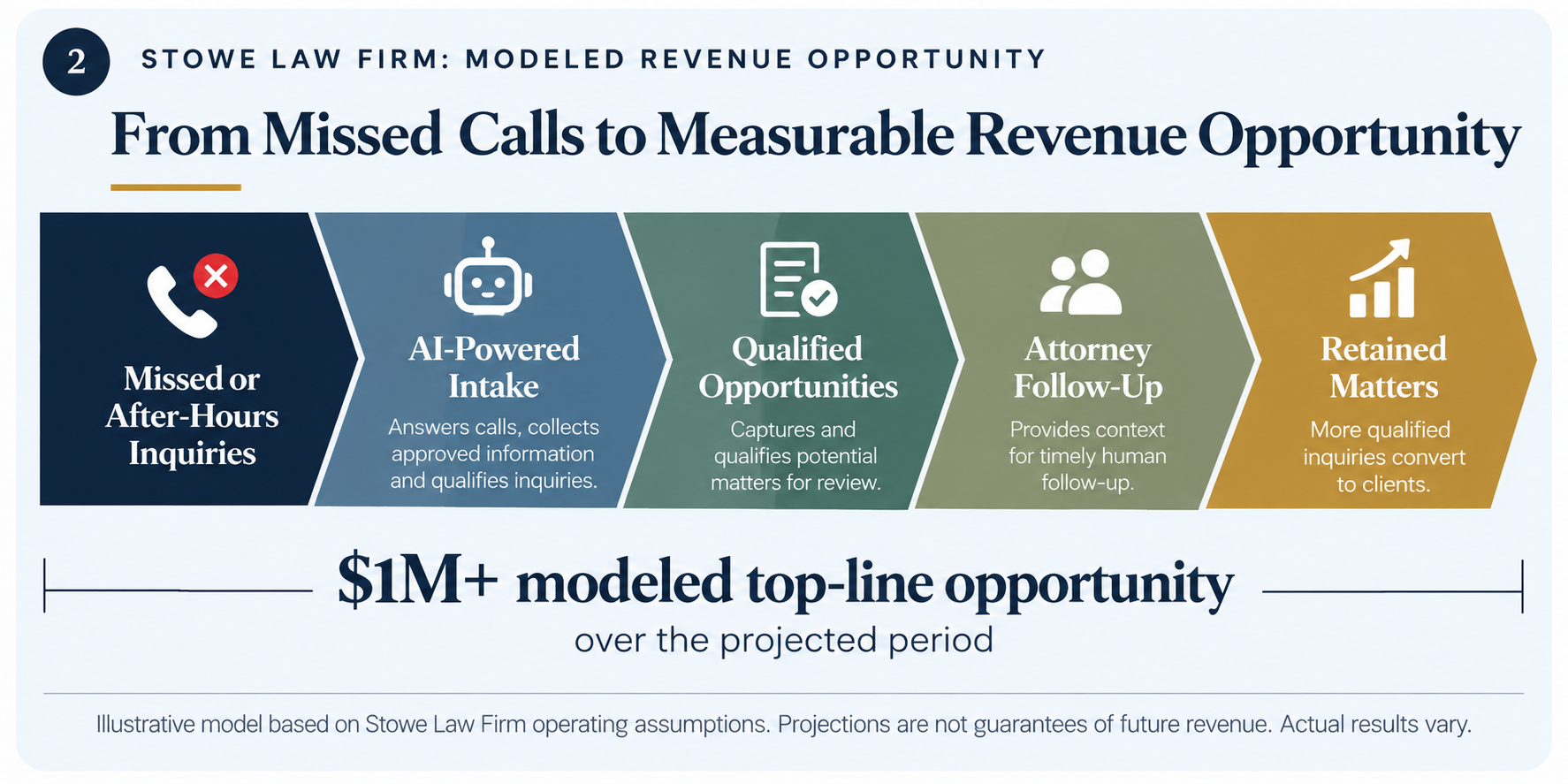
There is also a revenue opportunity at the front of the practice. Prospective clients often contact a firm when the need is immediate. If no one answers, the inquiry goes to voicemail, or the response comes hours later, the firm may lose the matter before an attorney ever has an opportunity to evaluate it. AI-powered intake and lead response can address that part of the client journey by responding when staff are unavailable, collecting approved information, qualifying the inquiry and giving the attorney context for the next conversation.
The Stowe Law Firm case study shows how Sierra Kru modeled this opportunity by examining the firm's intake process, call activity, qualification assumptions and case economics. The analysis identified more than $1 million in potential top-line opportunity over the modeled period if the firm could improve the capture and conversion of qualified inquiries. The projection was designed to estimate the economic value of the opportunity, not guarantee future revenue.
That distinction matters. The relevant question is not simply what an AI intake system costs, but what qualified opportunities may be worth when they are lost because the firm cannot respond at the moment a prospective client reaches out.
The model was supported by an early operating result. Within the first weeks of deployment, Stowe Law Firm reported converting a prospective client whose inquiry had been captured by the AI system while competing firms were unavailable. The system did not replace the attorney or make a legal judgment. It preserved the opportunity, gathered useful context and enabled timely human follow-up. Stowe subsequently reported at least two converted cases that the firm could directly identify after deployment.
Responsible AI adoption has to be designed into the workflow
Revenue growth is only one side of the AI decision. Law firms also have obligations around competence, confidentiality, client communication, supervision and the accuracy of the work they ultimately provide. ABA Formal Opinion 512 makes clear that the use of generative AI does not transfer those responsibilities away from the lawyer.
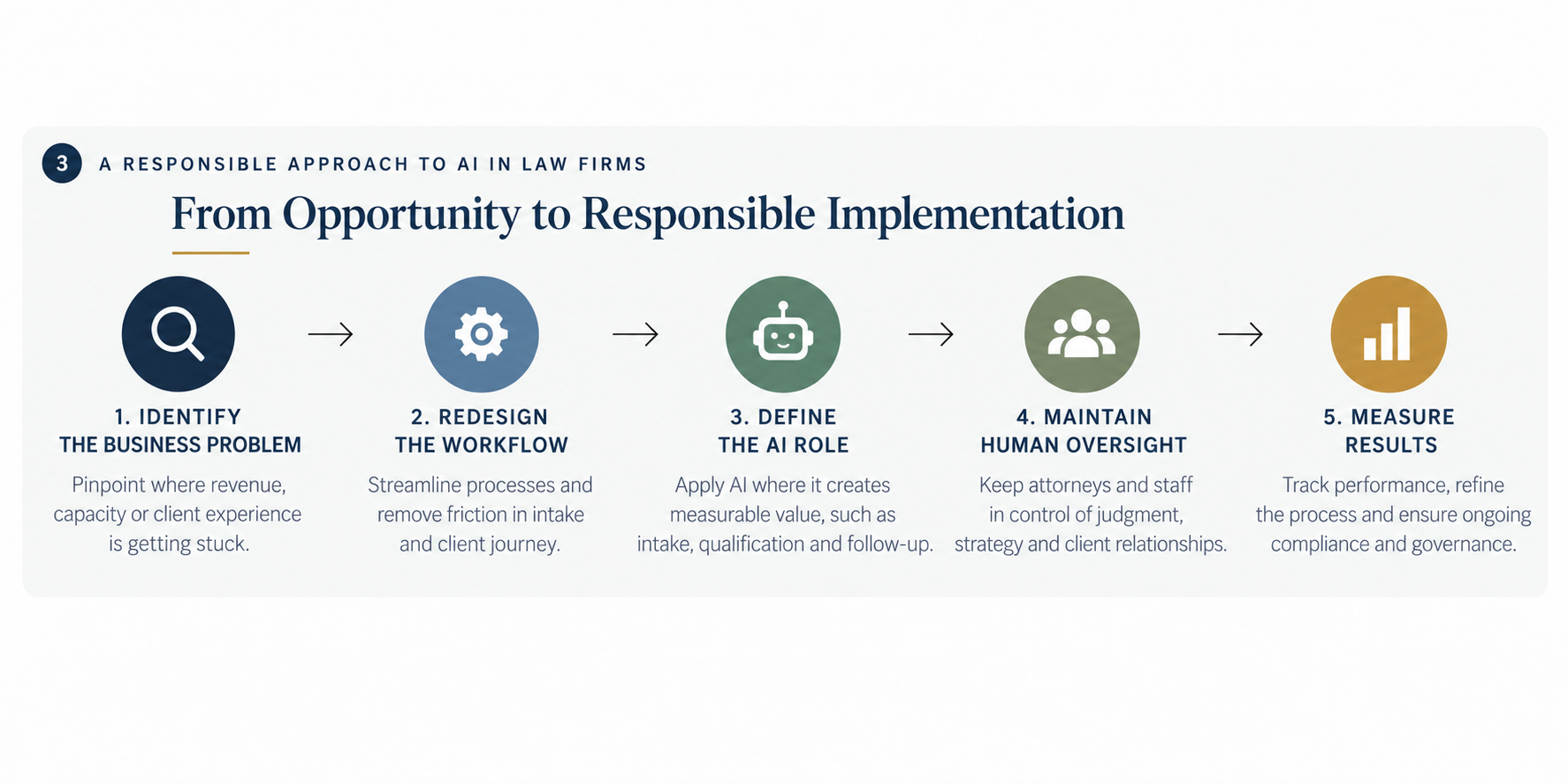
That means responsible AI adoption should begin with the workflow rather than the tool. Firms should identify the business problem first, determine what should be simplified or redesigned, define exactly what the AI system is permitted to do, establish where human judgment and escalation remain necessary, and then measure whether the system is producing the intended result.
For client intake, for example, AI might answer calls, collect approved information, identify the nature of an inquiry, support scheduling and prepare a structured summary for staff. The attorney still controls legal judgment, advice and the client relationship. That boundary is what turns AI from an isolated technology purchase into an operating system the firm can manage.
Thomson Reuters’ discussion of the GenAI governance gap offers a broader view of the same implementation challenge.
The next phase of AI in law
The legal industry is moving beyond the experimentation stage. AI adoption is already high; the harder work now is determining where it improves the economics of the firm and where stronger governance is required. Clio's research shows that the firms seeing stronger financial returns are not simply using AI more often. They are integrating it into workflows and changing how they use the time and capacity it creates.
For law firms, the opportunity is therefore broader than automation. AI can help a practice respond faster, preserve more qualified opportunities and recover attorney capacity, but only when it has a defined role, a measurable business purpose and clear human accountability.
The firms that create the most value from AI will not necessarily be the firms with the most tools. They will be the firms that know where AI belongs, what outcome it should improve, and where human judgment must remain.
Where should your firm start?
If your firm is losing inquiries because calls go unanswered or follow-up is inconsistent, explore AI-Powered Intake and Lead Response.
If the larger question is where AI should fit across the practice, start by understanding the firm's current AI readiness, opportunities and governance needs.
Losing qualified inquiries when your team cannot answer?
See how Sierra Kru helps law firms capture intake information and preserve opportunities when staff are unavailable.
Explore AI-Powered IntakeTrying to determine where AI belongs across the firm?
Assess your firm's opportunities, readiness and governance priorities before adding more tools.
Take the AI Readiness Assessment →